

Leadership is changing. Businesses are operating in increasingly fast-paced environments where communication, adaptability and human connection matter more than ever.
Employees expect leaders who can listen effectively, navigate difficult conversations and lead with confidence during periods of change.
At the same time, organisations are recognising that traditional training methods often fail to create meaningful behavioural change. Leadership is not developed through theory alone. It develops through experience, interaction and practice.
That is why businesses are placing greater emphasis on experiential leadership training that helps people build real-world leadership skills through immersive learning experiences.
So, what leadership skills will matter most in 2026?
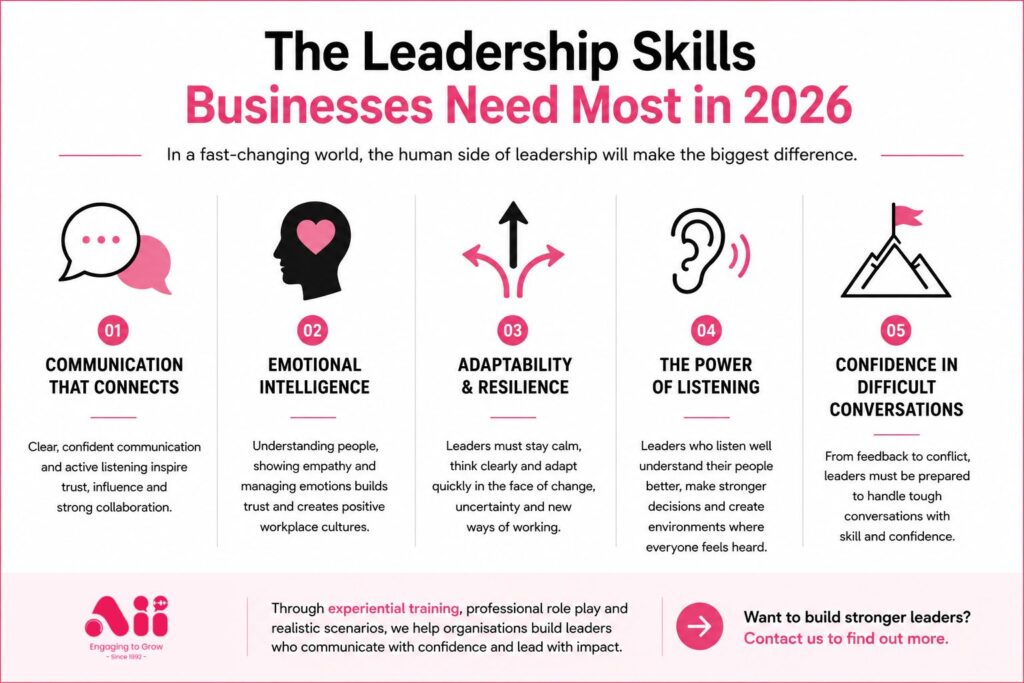
Communication Will Define Effective Leadership
One of the biggest challenges inside organisations is communication.
Leaders are constantly required to manage conversations that influence performance, collaboration and workplace culture. Whether it is delivering feedback, handling conflict or leading teams through uncertainty, communication shapes how leadership is experienced across an organisation.
In 2026, businesses will increasingly value leaders who can communicate clearly, listen actively and respond confidently in high-pressure situations.
These are skills that improve through realistic practice rather than passive learning.
Emotional Intelligence Will Become Essential
Strong leadership is becoming increasingly people-focused.
Employees want leaders who are approachable, emotionally aware and able to create environments where people feel heard and supported.
Emotional intelligence affects collaboration, engagement, conflict resolution and team morale. Businesses are recognising that leadership is not simply about managing tasks, it is about understanding people and responding effectively in challenging situations.
Experiential learning environments are particularly valuable because they allow leaders to practise interpersonal situations in real time while receiving immediate feedback.
Adaptability Will Matter More Than Ever
The workplace continues to evolve rapidly.
Hybrid working, changing employee expectations and constant organisational change mean leaders must be comfortable operating in uncertain situations.
Businesses need leaders who can remain calm under pressure, adapt their communication style and respond thoughtfully in the moment.
This is one reason why experiential leadership training is becoming increasingly valuable. Immersive learning allows participants to experience realistic workplace challenges rather than simply discussing them theoretically.
Confidence in Difficult Conversations Will Be Critical
Leadership often involves conversations people naturally avoid.
Performance concerns, conflict, stakeholder pressure and emotionally charged situations can all feel uncomfortable without the right preparation.
Many leaders struggle not because they lack knowledge, but because they lack opportunities to practise these situations safely before facing them in real life.
Practical learning experiences help leaders build confidence, improve communication and develop stronger responses in high-pressure interactions.
This Is Where Experiential Leadership Training Comes In
Many leadership programmes focus heavily on presentations and theory, but leadership is not developed through information alone.
It develops through communication, reflection and experience.
This is where experiential leadership training becomes so effective.
Rather than simply discussing leadership concepts, immersive learning allows participants to actively practise realistic workplace scenarios in a safe and engaging environment.
At Actors in Industry, we help organisations create meaningful behavioural change through professional role players, immersive workshops and realistic business simulations.
Our experiential approach helps teams strengthen communication, leadership confidence and interpersonal skills in ways that feel practical, authentic and directly relevant to the workplace.
Contact Actors in Industry to explore how our experiential leadership training programmes can support your teams.