When people hear the words “role play”, they often have one of two reactions.
Some immediately see the value. Others remember a training session where they had to pretend to be an angry customer while a colleague read from a worksheet.
That second experience is exactly why we take the creation of role play scenarios seriously at Actors in Industry.
For role play to be useful, it has to feel relevant to the people taking part. The situation needs to be recognisable, the character needs to feel believable and the conversation needs enough flexibility for participants to experience what it is actually like to navigate a difficult interaction.
That doesn’t happen by simply writing a script and handing it to an actor.
It starts with understanding what is really happening
When we create a role play scenario, we first need to understand what the organisation is trying to achieve. That might be helping managers give difficult feedback, handle disagreement or navigate challenging client conversations.
But the learning objective is only the starting point. We also look at what is actually happening: Which conversations are difficult? What tends to go wrong? What are people avoiding?
That context helps us turn a broad learning objective into a scenario that feels relevant, believable and close to real working life.
The person isn’t simply “difficult”
Real people aren’t simply difficult. An employee may react badly to feedback because they feel unheard, while a demanding client may be under pressure themselves.
That’s why our actors are briefed on the character’s motivations, concerns and likely responses. They aren’t waiting for the participant to say the “right” thing, they respond from the character’s perspective.
The result is a more natural conversation that gives participants something real to respond to.
We don’t want participants to know exactly what is coming
Real conversations rarely go exactly as planned, so good role play shouldn’t either.
A participant might expect someone to be defensive but find that they’re actually disappointed. They might ask a question that reveals a completely different issue, or make an assumption that causes the other person to push back.
Our actors respond to what happens in the conversation rather than following a fixed script. That means participants have to listen, adapt and decide what to do next, just as they would in a real workplace conversation.
The aim isn’t to remember the “right” response. It’s to learn how to respond to the person in front of you.
The challenge needs to be realistic
There’s a balance to strike when designing a scenario. If the conversation is too easy, participants don’t get much opportunity to practise. If it’s unnecessarily confrontational, the focus can shift from developing the skill to simply getting through the exercise.
The level of challenge should reflect the learning objective. The character might push back, become emotional or say very little, requiring the participant to listen carefully and ask the right questions.
And the scenario doesn’t need to be dramatic to be difficult. A manager giving feedback to a high-performing employee, a senior colleague challenging a decision or a professional managing a difficult client conversation can all be challenging in very different ways.
The aim is to recreate the kind of conversations people actually have at work and give them the chance to practise handling them well.
A Recent Example from the Classroom
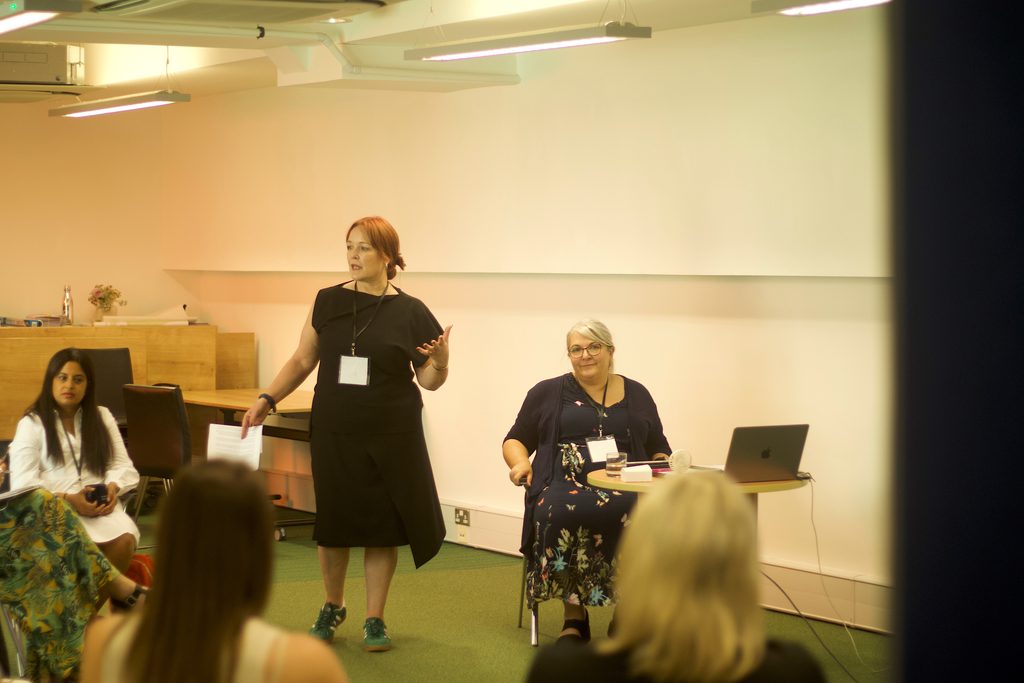
In a recent Leading in Audit workshop, participants explored two common management situations through Forum Theatre: dealing with an unmotivated team member and having a wellbeing conversation.
Both scenarios were deliberately grounded in the kinds of situations managers can face at work. Participants could explore different approaches, see how the conversation changed depending on what was said and consider what they might do differently in a similar situation.
That’s the value of realistic role play. It gives people a chance to practise the judgement and communication needed for a real conversation, without having to get it right the first time at work.
Good role play shouldn’t feel like acting
Ultimately, our job isn’t to create a performance.
It’s to create a situation in which someone can practise something that matters.
The scenario needs enough realism to make the participant engage with it, but enough flexibility for them to make decisions, try different approaches and learn from the outcome.
We don’t want people to leave a session thinking they were good at role play.
We want them to leave feeling more prepared for the conversation they may have next week.
Because you can read about difficult conversations. You can learn a framework. You can discuss active listening, empathy and questioning. But there comes a point where you have to practise.
And when that practice feels close enough to real life, the learning becomes much more meaningful.
That’s what we aim to create at Actors in Industry: real conversations, realistic challenges and a safe place to practise before it matters for real.
If you’re looking at using role play in your next learning programme and want to explore what realistic scenarios could look like for your team, we’d be happy to talk.