
Introduction to Corporate Improvisation
Corporate improvisation training is one of the most misunderstood and underused approaches in professional learning and development. For many organisations, the word improvisation still conjures images of comedy or theatre, which leads L&D and HR professionals to overlook a methodology that has been producing measurable changes in communication, collaboration and leadership behaviour for decades.
When it is understood and applied correctly, improvisation is not about performance or entertainment. It is a rigorous, evidence-informed approach to developing the behavioural skills that determine how well people work together, how effectively they lead and how confidently they navigate the unscripted complexity of real business life.
What Corporate Improvisation Training Actually Is
At its core, corporate improvisation training is a form of experiential learning that uses the principles and exercises of applied improvisation to develop workplace behaviour. It draws on the same techniques used in professional acting training, particularly the discipline of responding fully and honestly in the present moment, and translates them into a structured learning environment for business professionals.
Unlike conventional corporate training courses that deliver content through slides, videos or facilitated discussion, corporate improvisation training works by placing participants in situations where they must respond, adapt and collaborate in real time. The learning does not come from being told what good communication looks like. It comes from experiencing it directly, feeling the difference between listening with full attention and half-listening while preparing your next contribution, between building on someone else’s idea and redirecting it, between being genuinely present in a conversation and simply waiting for your turn to speak.
This experiential quality is precisely what makes the methodology so effective, and it is why organisations across professional services, financial services, technology, healthcare and the public sector have been integrating it into their leadership communication training and team development programmes for many years.
The Business Case for Improvisation in the Workplace
The skills that improvisation develops are not soft skills in the dismissive sense that phrase is sometimes used. They are the precise behavioural competencies that determine whether a senior manager can lead a difficult conversation constructively, whether a team can collaborate effectively under pressure, whether a client-facing professional can respond with confidence and clarity when a conversation takes an unexpected turn.
Research into organisational performance consistently identifies communication quality as one of the primary differentiators between high-performing teams and those that struggle. Poor listening, defensive responses, an inability to think clearly under pressure and a lack of psychological safety within groups are among the most commonly cited barriers to effective collaboration. Corporate improvisation training addresses each of these directly, not through instruction but through experience.
When participants practise the principle of “yes, and,” the foundational exercise in applied improvisation through which each person accepts what the previous person has said and builds on it, they are not learning a communication technique. They are physically experiencing what it feels like to have their contribution accepted and built upon rather than rejected or redirected, and they are developing an intuitive understanding of how that dynamic shifts the quality of interaction within a group. That understanding carries back into the workplace in a way that a slide about active listening simply cannot replicate.
How Corporate Improvisation Training Works in Practice
A well-designed corporate improvisation training session is structured around a series of exercises that build progressively in complexity and challenge. Participants begin with exercises that focus on attention and presence, developing the capacity to listen fully rather than partially, before moving into exercises that explore collaboration, spontaneity, confidence under pressure and the dynamics of group interaction.
Throughout the session, a skilled facilitator draws explicit connections between each exercise and the workplace behaviours it relates to. This reflective dimension is essential because it bridges the gap between the experience and its practical application, helping participants understand not just what they did but why it matters and how it translates to their day-to-day roles as managers, leaders and team members.
The most effective programmes use corporate improvisation training as a component within a broader learning and development strategy, combining it with other forms of experiential learning such as professional role play, skills practice and behavioural communication coaching to create an integrated approach to development. When it is positioned in this way, improvisation acts as an accelerant, creating the psychological openness and interpersonal trust that allows other forms of learning to land more effectively.
The Specific Outcomes Organisations Can Expect
Organisations that invest in corporate improvisation training as part of their L&D strategy typically report improvements across several distinct areas of performance.
In terms of communication quality, participants develop stronger active listening habits, greater confidence in unscripted situations and a more natural ability to respond constructively rather than reactively. Managers who have been through improvisation-based training tend to report feeling more at ease in challenging conversations and better equipped to adapt their communication style to different people and contexts.
In terms of team dynamics, the shared experience of improvisation exercises has a demonstrable effect on psychological safety within groups. When a team practises together, the exercises create conditions in which vulnerability, experimentation and honest response are normalised rather than suppressed. This tends to accelerate the development of trust within the team and improve the quality of collaboration on real work challenges.
In terms of leadership development, corporate improvisation training develops the capacity for what might be described as leadership presence, the ability to hold attention, project confidence, think clearly under pressure and engage others authentically. These qualities are difficult to teach through conventional training courses and respond particularly well to the direct, embodied experience that improvisation provides.
Why Experiential Learning Methods Produce Lasting Behavioural Change
One of the most significant limitations of traditional corporate training courses is the gap between what people learn in the room and what they actually do differently back at their desks. Research into learning retention consistently shows that passive information delivery, whether through a lecture, a webinar or an e-learning module, produces low levels of long-term behavioural change. People remember a fraction of what they are told and apply an even smaller fraction in practice.
Experiential learning methods such as corporate improvisation training work differently because they engage participants at a physical and emotional level as well as a cognitive one. When someone experiences a genuine moment of connection, clarity or confidence during an improvisation exercise, that experience creates a memory trace that is qualitatively different from having been told that connection, clarity and confidence are desirable outcomes. The body remembers what the mind has experienced, and that physical memory is what drives the transfer of learning into behaviour.
This is the fundamental argument for building experiential methods into your L&D strategy and for using corporate improvisation training specifically as a vehicle for developing the communication and collaboration competencies that matter most to your organisation.
Is Corporate Improvisation Training Right for Your Organisation?
Corporate improvisation training is particularly well suited to organisations that are dealing with communication challenges at a team or leadership level, that are looking for new approaches to team development that go beyond conventional workshops, or that want to create a stronger culture of collaboration, openness and psychological safety within their teams.
It is most valuable for leaders and managers who need to develop their presence and confidence in unscripted situations, for teams that are working across functions, geographies or cultures and need to improve the quality of their everyday interaction, and for L&D professionals who are looking for a methodology that they can experience directly before recommending it to their stakeholders.
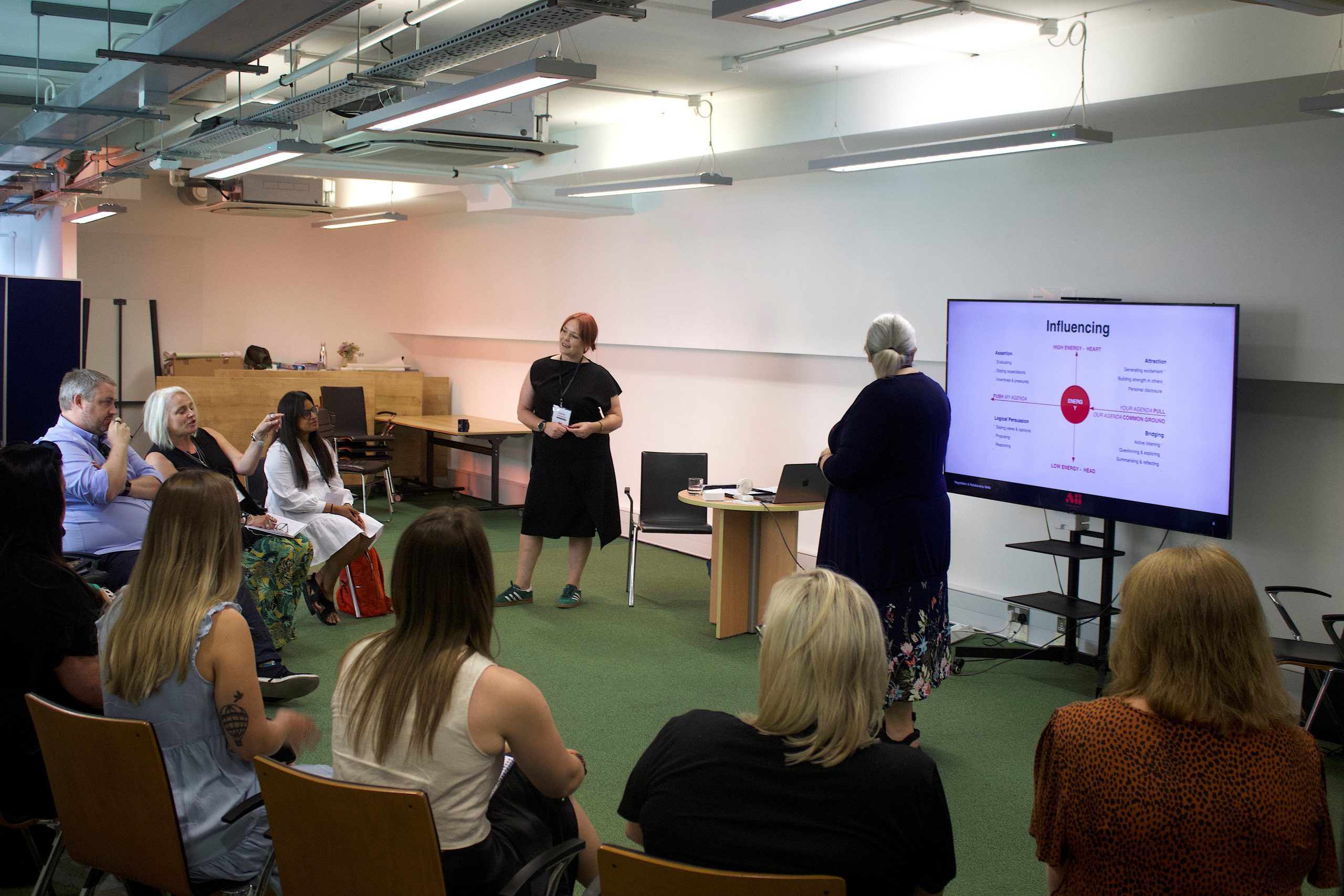
If you are responsible for developing people in a large organisation and you want to understand how corporate improvisation training works before considering it for your teams, our open events offer a practical starting point. Each session gives participants a first-hand experience of the methodology in a small group, facilitated by professional practitioners with deep expertise in applied improvisation and behavioural communication training.
Our next Corporate Improvisation open session takes place on 30th June in London, offering L&D professionals, HR leaders and managers a direct, hands-on introduction to the methodology. Register your place and experience it for yourself.