

There’s a quiet assumption many professionals carry with them: that confidence and capability will come with time. That with enough reading, enough observing, and enough thinking, they’ll eventually feel ready.
It sounds reasonable. But in practice, it rarely works that way. Because capability isn’t built through knowing. It’s built through doing. And more specifically, through practising.
Why Knowledge Alone Doesn’t Translate Into Performance
In most organisations, learning is prioritised. People attend workshops, consume content, and walk away with insights that make sense in the moment. Yet when they find themselves in a difficult conversation, faced with conflict or pressure, that clarity disappears.
They hesitate. They soften their message. Sometimes, they avoid the situation altogether.
It’s not because they didn’t understand the material. It’s because they never had the chance to practise it.
There’s a fundamental difference between understanding something intellectually and being able to execute it under pressure. When the stakes are high, people don’t rise to the level of their knowledge. They fall back on what feels familiar and familiarity only comes from repetition.
Practice: The Missing Link Between Learning and Capability
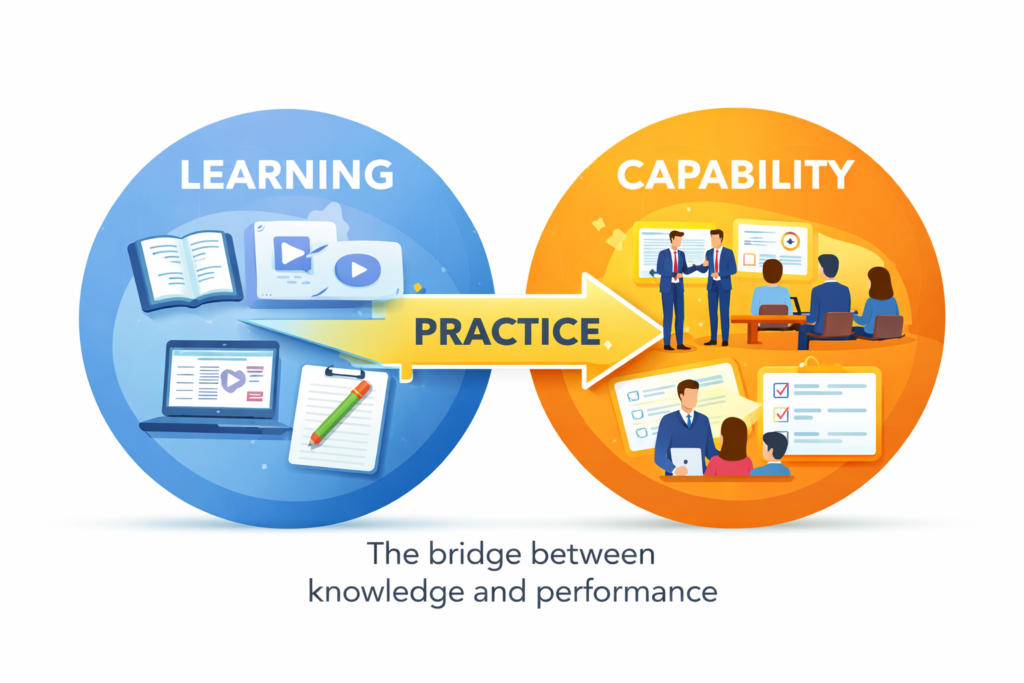
This is where most development efforts fall short. Learning is treated as the outcome. In reality, it’s only the starting point.
Practice is what turns insight into action. It allows people to take an idea and test it, refine it, and make it their own. Over time, responses become quicker, more natural, and far less forced. Confidence begins to build, not from theory, but from experience.
This is why environments that simulate real situations are so effective. When people are placed in realistic scenarios, they are forced to engage, respond, and adapt in the moment. That’s where real capability starts to form.
Why Practice Is Often Avoided
Despite its importance, practice is often the first thing to be removed.
It can feel uncomfortable. It requires time. It asks people to step outside their usual patterns and risk getting it wrong in front of others. For many organisations, it feels easier to keep learning theoretical—safe, controlled, and predictable.
But avoiding practice doesn’t remove discomfort. It simply delays it.
And when it shows up later, it does so in situations where the stakes are real and the consequences matter.
What Happens When Practice Is Missing
The impact of this gap is subtle at first, but significant over time.
Conversations that should happen are postponed or avoided entirely. Feedback is diluted to the point where it loses meaning. Small issues grow into larger problems because they were never addressed clearly in the first place.
Teams begin to experience friction, not because people lack knowledge, but because they lack the confidence to apply it. Leaders second-guess themselves in moments that require clarity and decisiveness.
Over time, this affects trust, performance, and the overall effectiveness of the organisation.
Practice as a Way to Accelerate Experience
One of the biggest misconceptions about capability is that it simply comes with time.
In reality, it comes with exposure.
Practice allows organisations to compress years of experience into shorter, more focused learning cycles. By simulating real scenarios, people are able to encounter challenges, test responses, and learn from mistakes in a safe environment.
They don’t have to wait for the “right moment” to learn. They create those moments intentionally.
And that’s what makes practice such a powerful shortcut.
From Learning to Doing: A Shift in Approach
The organisations that build real capability think differently about development.
They don’t just ask what their people need to know. They ask what their people need to be able to do—and then create opportunities for them to practise it.
They design learning experiences that go beyond information and focus on behaviour. They create space for repetition, feedback, and reflection. And most importantly, they normalise getting things wrong as part of the process.
Because that’s where growth actually happens.
Final Thought
Capability isn’t something that appears with time or experience alone. It’s something that is built deliberately, through action and repetition.
If you want people to perform when it matters, they need more than knowledge. They need practice.
Because in the moments that count, people don’t rely on what they’ve learned. They rely on what they’ve done before.
And this is exactly the work we do every day. Through practical, scenario-based training, we help teams build the confidence and capability that only comes from doing, not just knowing.
If that’s something your team could benefit from, we’d love to explore it with you.
Frequently Asked Questions
1. Why is practice more important than knowledge when building capability?
Knowledge provides understanding, but practice creates behaviour. In high-pressure situations, people don’t stop to recall theory, they rely on what feels natural. Practice builds that familiarity, allowing individuals to respond with clarity and confidence rather than hesitation.
2. How can organisations create opportunities for practice at work?
Organisations can introduce practice through structured role-play, scenario-based workshops, peer-to-peer simulations, and facilitated training sessions. The key is to replicate real workplace situations so employees can apply what they’ve learned in a safe but realistic environment.
3. What types of skills benefit most from practice-based learning?
Any skill that involves human interaction benefits significantly from practice. This includes communication, leadership, conflict resolution, negotiation, and giving feedback. These are behavioural skills that can’t be mastered through theory alone, they require real application.
4. Why do employees struggle to apply training in real situations?
Most training focuses heavily on concepts but lacks practical application. Without repetition and feedback, employees may understand what to do but feel unsure when it comes to actually doing it. This gap between knowing and doing is what prevents training from translating into performance.
5. How often should teams practise skills like communication and leadership?
Practice should be ongoing rather than a one-time activity. Regular, short practice sessions are far more effective than occasional training events. Consistent exposure helps reinforce behaviours, build confidence, and ensure skills become second nature over time.